
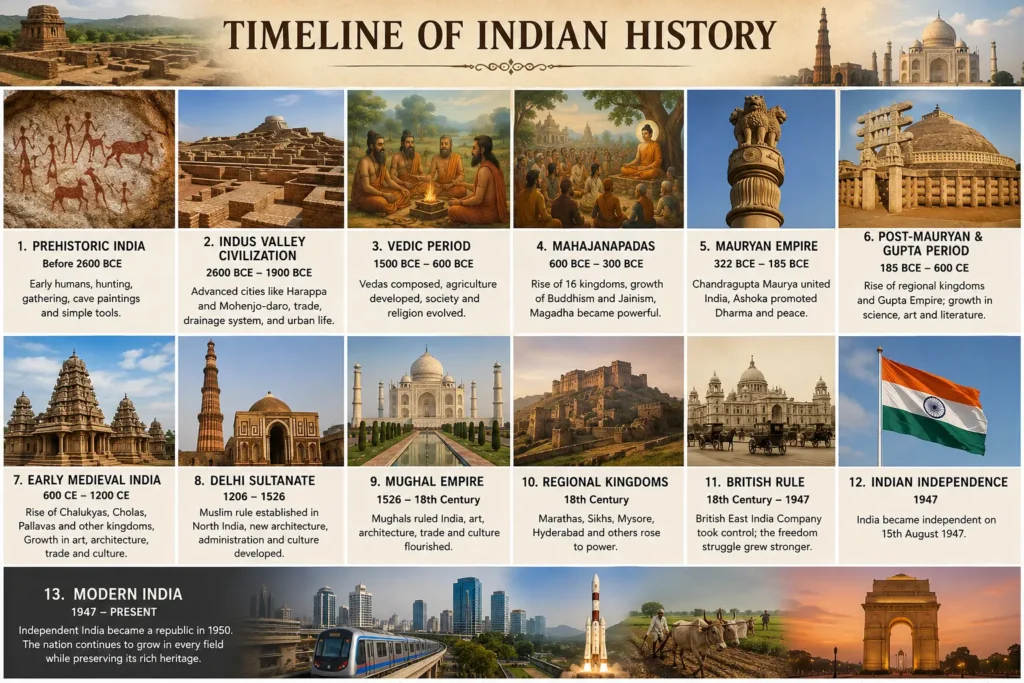
Indian history is a comprehensive concept that covers numerous events, occurrences, and developments in one of the world’s oldest and most multicolored civilizations. From the prehistory of the Indian subcontinent to contemporary times, India saw the ascension and decline of multiple kingdoms and empires, experienced foreign invasions and periods of isolation, gave birth to great philosophies and public figures, saw the introduction of diverse cultures and social transformations, got colonized by foreigners, and eventually gained independence.
It might be overwhelming for a person to get an accurate and complete picture of Indian history as a whole. That is why it might be helpful to create a timeline of the most significant events for a better understanding of the development of Indian society.
Indian History Timeline at a Glance
Below you can find a list of eras that are considered significant for the Indian history timeline:
- Prehistoric India → Indus Valley Civilization → Vedic Period → Mahajanapadas → Mauryan Empire → Post-Mauryan Period → Gupta Empire → Early Medieval India → Delhi Sultanate → Mughal Empire → Regional Kingdoms → British Rule → Indian Independence → Modern India
Now, let’s take a closer look at each of the mentioned eras.
- Prehistoric India
India’s history started many millennia ago when the first people came to present-day India from unknown places and lands. Nomadic hunters and gatherers, they slowly discovered the techniques of domestication of plants and animals.
Numerous excavations in different parts of the Indian subcontinent revealed the remains of people who lived in caves and built permanent settlements using stone tools and painted pictures on the walls.
Sedentary life enabled people to create the most primitive forms of civilization, so it was not a surprise to see cities and primitive societies develop on the Indian subcontinent.
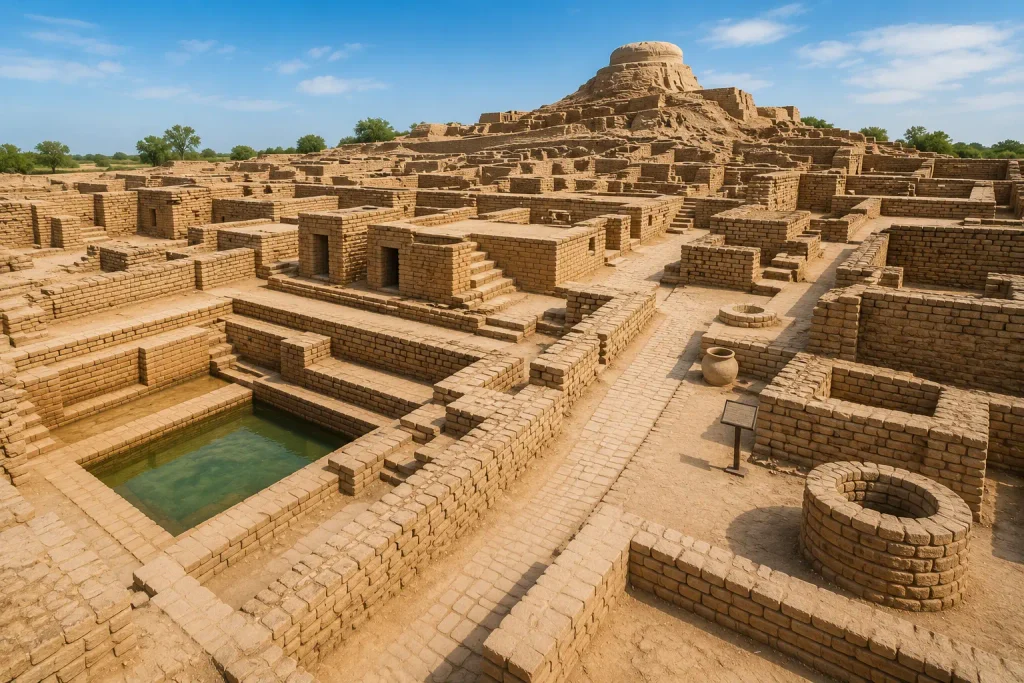
- Indus Valley Civilization – c. 2600-c. 1900 BCE
The most significant ancient Indian culture that is considered to be the primeval stage of Indian civilization is known as the Indus Valley Civilization.
This culture developed alongside the Indus River and covered a vast area of today’s Pakistan, western India, and eastern Afghanistan.
The cities of Harappa, Mohenjo-daro, Dholavira, and Lothal were the most famous and prosperous ones among many others in this civilization. Archaeologists discovered numerous artifacts, remains of houses, wells, water channels, and even jewelry and precious metals in these cities.
It was also found out that the Harappans were excellent traders who built networks of commerce that reached Central Asia and the Persian Gulf. Historians and archaeologists still try to find out the reason why this great civilization disappeared at the beginning of the 2nd millennium BCE.
- Vedic Period – c. 1500-c. 600 BCE
After the Indus Valley Civilization, Indian history moved on to the period that saw the creation and development of the Indian culture and identity. This period is known as the Vedic period or the Vedic era.
It got its name from the Vedas, a large collection of ancient hymns, poems, and philosophical writings thought to have been written between the 15th and 12th century BCE.
This age is also famous for the first appearance of Indian philosophical practices and Vedic religion. The first agricultural lands were developed, followed by the emergence of the first tribal societies. The latter gave the Indians a sense of identity.
- Mahajanapadas – c. 600-c. 300 BCE
As Indian history moved on to the next era, new Indian kingdoms and principalities emerged in the territory of present-day India. The most prominent and powerful among them is known as the Mahajanapadas.
Ancient India’s history strongly correlates with the life and activity of one of the greatest Indian teachers and philosophers, Gautama Buddha.
An important feature of the second half of the first millennium BCE was the development and spread of Indian religions such as Buddhism and Jainism.
The influence of these religions extended far beyond the borders of India and affected Indian history for many centuries.
- Mauryan Empire – c. 322-185 BCE
The ancient Indian history timeline covers numerous significant events and milestones. One of them is the Mauryan Empire, the largest empire ruled in ancient India and one of the most influential on Indian history as a whole.
The empire was founded by Chandragupta Maurya, a great Indian warrior and leader.
It is believed that Chandragupta’s grandson, a renowned Indian emperor and Buddhist philanthropist, had significant influence over the rest of India and beyond, including Southeast Asia, Central Asia, and Sri Lanka.
Ashoka made it his life’s mission to bring peace, prosperity, and happiness to all people across the world.
- Post-Mauryan Period and Gupta Empire
The downfall of the Mauryan Empire in the 2nd century BCE brought forth several smaller empires and kingdoms ruled by different dynasties of Indian origin and foreign ones.
The fourth century BCE saw the emergence of one of the most powerful Indian kingdoms in history, Gupta. This empire’s significance for Indian history is immense: mathematics, astronomy, and Indian culture experienced unprecedented growth.
In addition to it, the Gupta Empire lasted for several centuries and covered a vast territory.
The most notable thing about the empire is that it did not occupy the whole subcontinent because, at the time, there also existed numerous local kingdoms.
- Early Medieval India – c. 600-c. 1200 CE
Following the fall of the Gupta Empire, a new age in Indian history started. A large number of kingdoms and empires emerged throughout the Indian subcontinent. They are historically known as the Early Medieval India period.
Many of the dynasties of this era were not only powerful but also influential in the cultural, social, and religious development of Indian society.
The most famous and the most influential ones are the Chalukyas, Pallavas, Cholas, Rashtrakutas, Palas, and Pratiharas. South India, in particular the Chola Empire, played a special role in Indian history as it was the center of trade and culture.
During this period, Indian history underwent a significant development in terms of culture and civilization. The most iconic monuments and temples were built in different parts of the country.
- Delhi Sultanate – 1206-1526
The next era in the historical timeline of India began in the early 13th century when the Muslim Delhi Sultanate was established on the territory of present-day Delhi.
Although the Delhi Sultanate was not a single dynasty but a series of Turkish, Afghan, and Persian dynasties, the period is known as the Delhi Sultanate period.
Numerous wars and battles took place during this period, and the Indian subcontinent was in a constant state of military conflict.
There is no doubt that sultans made significant contributions to Indian culture, art, architecture, music, and literature.
Also, there were many strong kingdoms in India during the time of the Delhi Sultanate period.
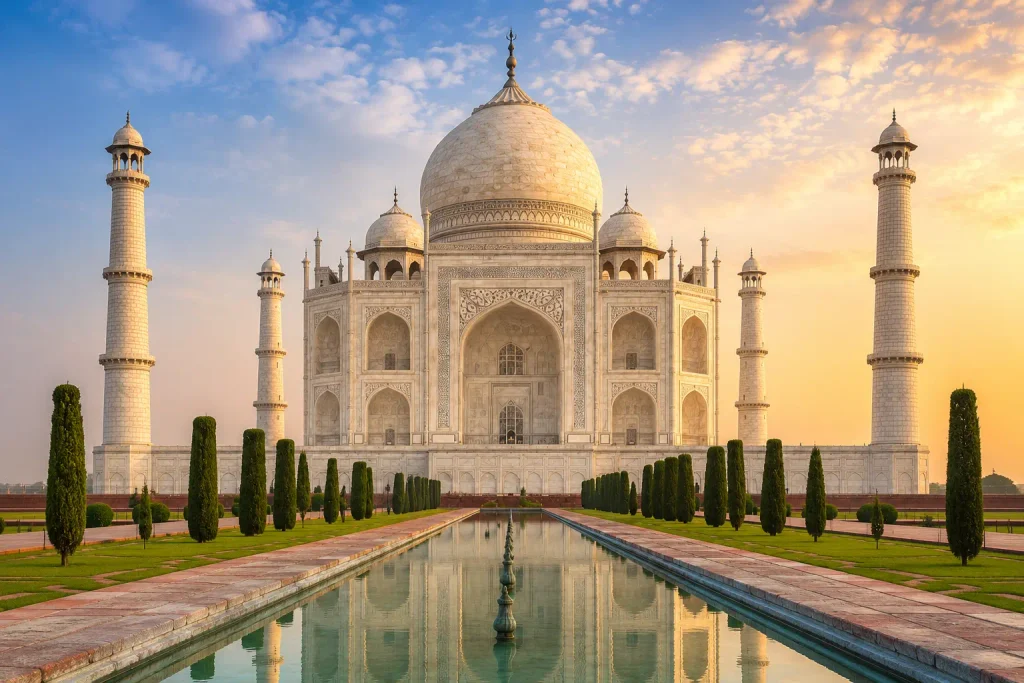
- Mughal Empire – 1526-18th Century
The Mughal Empire was the largest empire ruled in India and one of the most powerful ones at the time. The Mughal Empire timeline starts from 1526 when Babur, a Turko-Mongol prince and warrior, conquered northern India.
The Mughal empire was characterized by outstanding scientific, technological, and cultural achievements of the Indian people.
It should also be noted that Akbar the Great, one of the most beloved and respected Mughal emperors, implemented brilliant and progressive policies.
The Mughal Empire enjoyed great wealth and influence for almost three centuries.
The next period in the Indian history timeline covers the time when the Mughal Empire was disintegrated.
Numerous Indian principalities and states emerged during this period on the territory of the former Mughal Empire.
Nevertheless, the Mughal Empire’s influence persisted throughout the first half of the 18th century when the political power and strength of the empire were considerably weakened.
This influenced the emergence of the Marathas, Sikhs, Mysore, Hyderabad, and many other independent states.
- British Rule – 18th Century-1947
The British East India Company became a considerable political and economic force in India in the 18th century.
Major battles and uprisings, such as the Battle of Plassey and the Battle of Buxar, ended with the victory of the British and their incorporation in the political and administrative strata of Indian society.
Thus, the British East India Company became the actual ruler of India.
Nevertheless, the Indian independence movement grew stronger with time, and the British colonial rulers had to deal with numerous problems, such as the Revolt of 1857.
In 1858, the British government took over direct control of India.
Later, in the late 19th and early 20th centuries, the Indian independence movement gained considerable traction. Many Indian leaders, such as Mahatma Gandhi, Jawaharlal Nehru, Subhas Chandra Bose, Sardar Patel, and many others, as well as millions of anonymous Indians, laid the foundation for the final chapter in India’s colonial history.
- Indian Independence – 1947
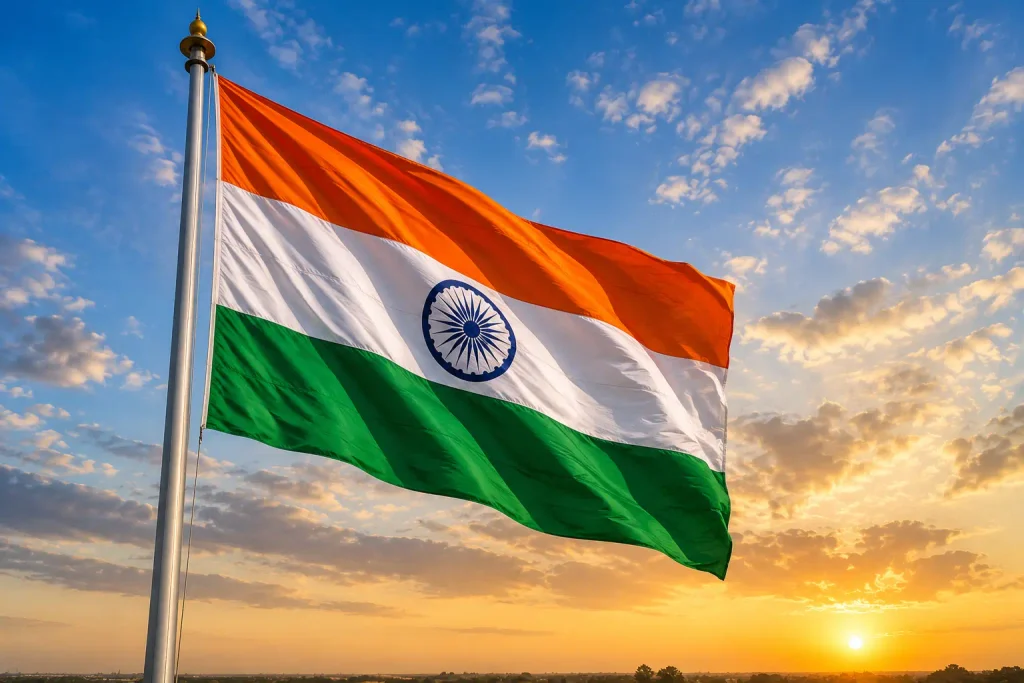
The culmination of the long struggle for freedom was the declaration of India’s independence on August 15, 1947.
The newly proclaimed Indian independence was accompanied by the painful partition of British India into two separate countries: India and Pakistan.
Still, this event marked India’s new era. Indian history knew many significant turning points. From the ancient Indian history period to the modern one that continues to this day, each era has its remarkable events and figures.
The timeline of Indian history can be applied to different periods and levels of Indian history.
- Modern India – 1947-till Now
Modern India timeline covers the period from 1947 to the present day. The newly founded republic adopted its constitution in 1950, and the President of India was elected.
Modern history of India cannot be fully understood without considering the vast number of political, social, and cultural changes that took place since 1947.
India was faced with numerous challenges and issues, including the separation from Pakistan and other countries, economic and political difficulties, and external and internal security threats.
Nevertheless, modern India has evolved from a newly founded sovereign state into a global economic and political power.
Final Thoughts
Indian history is complex and multilateral, and each era and period brings its unique and outstanding features.
Indian history timeline is vast and covers numerous events, from the ancient Indian history period to the modern times.
The purpose of this article was to provide a brief overview and the short description of each of the eras.
Still, there is much more to explore in the field of Indian history exploration.