
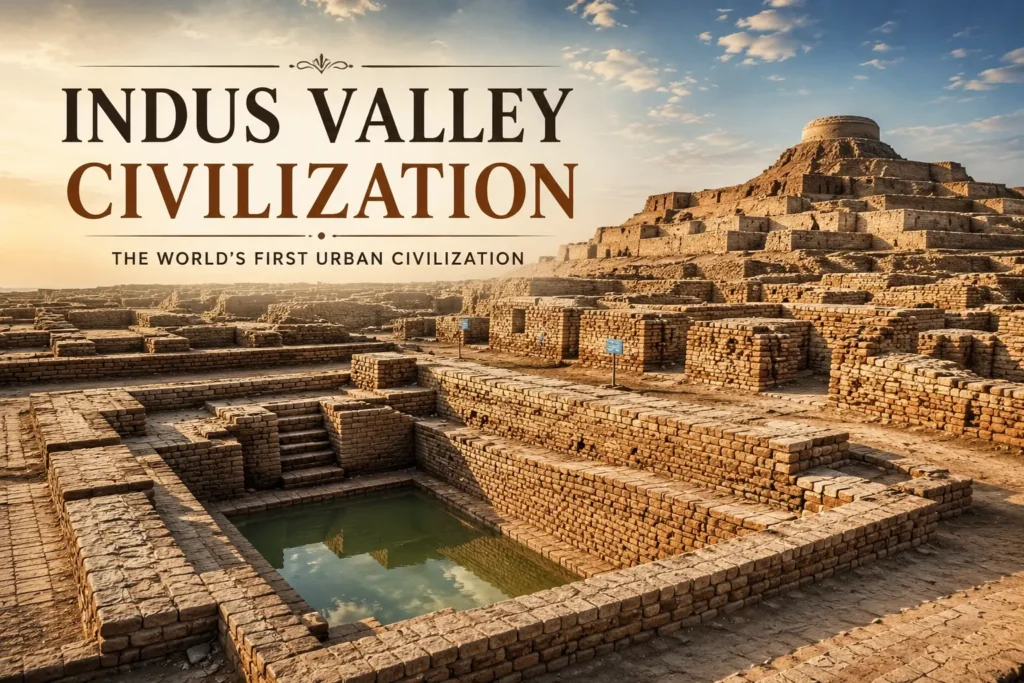
Imagine walking through a city where the streets are planned, the houses have drains, the markets bustle, and people have already mastered building with standardized bricks.
Now imagine that this city existed more than four thousand years ago.
Long before many of the world’s famous empires rose to power, there was a remarkable civilization already flourishing across parts of present-day India and Pakistan. This was the Indus Valley Civilization, also known as the Harappan Civilization. It was one of the world’s earliest urban civilizations – and perhaps one of its most mysterious.
The people built impressive cities, traded across distant regions, crafted beautiful pottery and jewelry, and led an organized urban lifestyle; however, there is one thing they left behind that historians still struggle to comprehend, their writing has not yet been deciphered.
So, who were the people of the Indus Valley? How did they live? And, what happened to their cities?
Let’s travel back thousands of years to learn about their story.
Where Did the Indus Valley Civilization Begin?
The civilization developed around the Indus River system and spread across a huge area of South Asia. The civilization spanned parts of modern-day Pakistan and northwestern India and also included a few sites well outside of the Indus Valley. The civilization did not appear to come to exist suddenly; rather its roots can be traced to earlier farming communities which gradually evolved more complex ones.
The period generally associated with the Mature Harappan phase dates to roughly 2600-1900 BCE. During this period, cities became large, trade expanded, and urban planning was at an impressive level.
Some of the most famous archaeological sites include:
Harappa
Mohenjo-daro
Dholavira
Lothal
Kalibangan
Rakhigarhi
Each site provides another part of the picture. And the picture is a large one.
Mohenjo-daro – A City Ahead of its Time
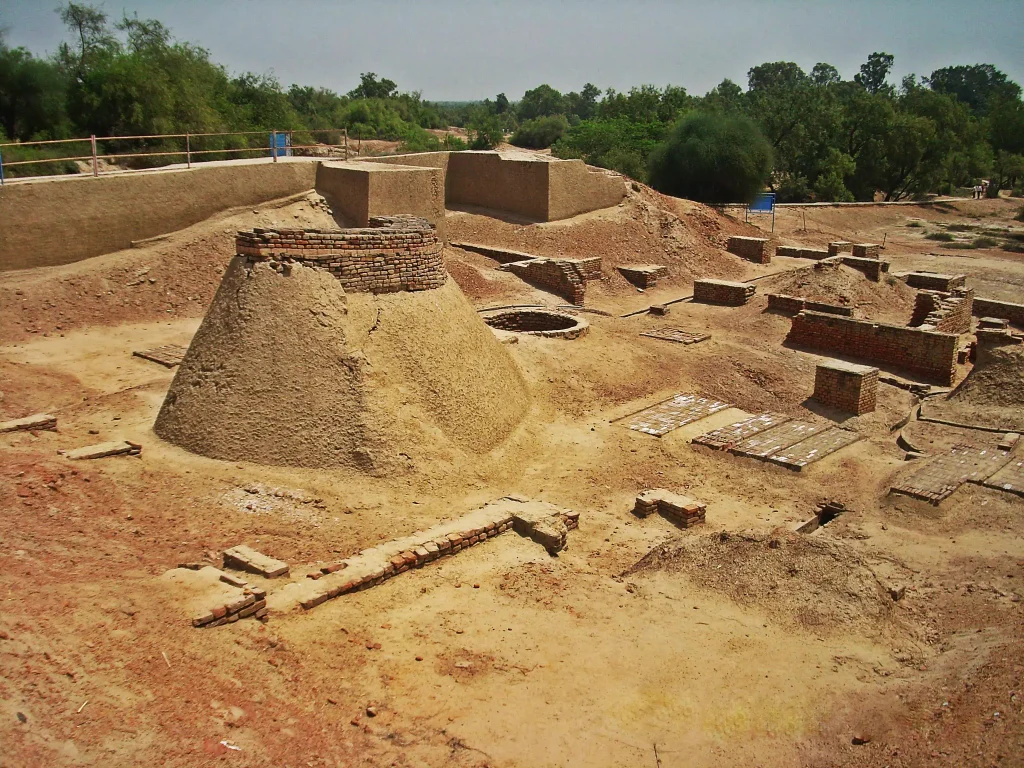
Among the most fascinating cities of the civilization is Mohenjo-daro located in present-day Sindh, Pakistan. Its name is commonly translated as ‘Mound of the Dead‘ – but, when the city was alive, it was anything but dead.
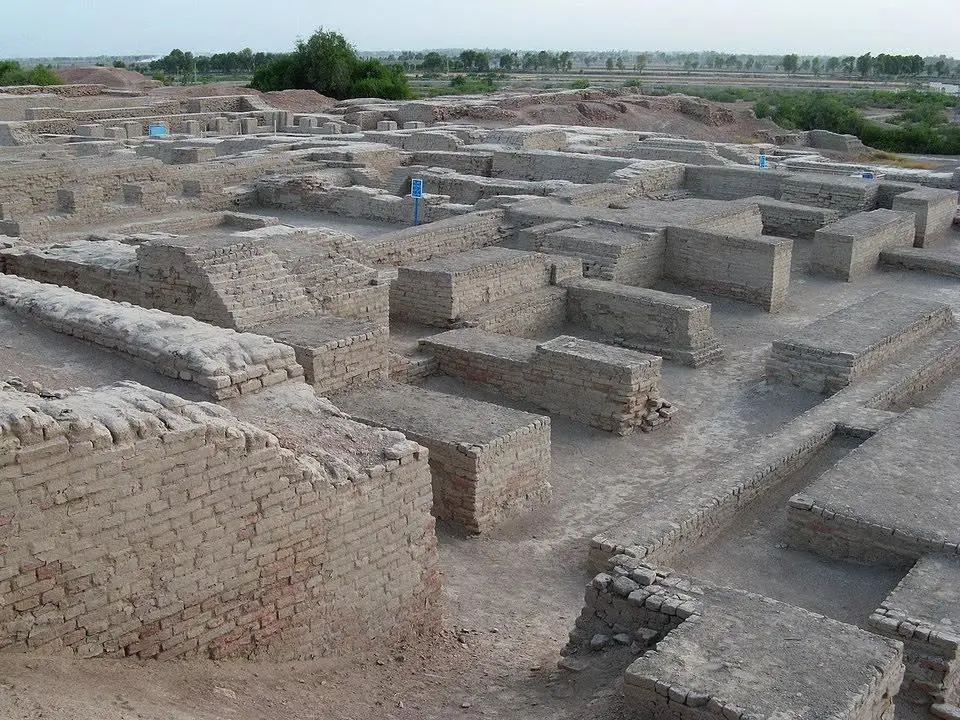
Mohenjo-daro contained arranged streets, houses, wells, public constructions, and an advanced drainage system.Most house buildings contained courtyards and some had private bathing areas connected to drainage channels.
Let’s think about it for a moment.
Thousands of years ago, residents were designing cities where wastewater could be moved away through planned drainage. Mohenjo-daro is also famous for its Great Bath.
Mohenjo-daro reminds us that ancient does not necessarily mean primitive.
The Harappans – Master City Planners
One of the greatest achievements of the Indus Valley Civilization was its approach to urban planning. Many cities had organized layouts, with streets arranged in grid like formats and buildings constructed with standardized bricks which suggests that there were common measurements and construction practices within communities. There were also systems for managing water and waste which implies that the Harappans understood that a city needed planning in order to become a great city.
The accomplishments were not only large monuments; on the contrary, their greatness can quite often be seen in the drains, wells, bricks, houses, roads, and storage areas. That is one of the most fascinating parts about the civilization.
Their story isn’t simply written in palaces.
It is written in the streets.
The Indus Valley Had a Surprisingly Wide Trade Network
The Harappans were not isolated. Archaeological discoveries indicate that they traded with regions beyond South Asia. Harappan goods and materials have been linked with areas which were associated with ancient Mesopotamia and regions around the Persian Gulf. They traded products such as beads, pottery, metals, textiles, and other crafted goods.
The city of Lothal located in present-day Gujarat is particularly famous for its evidence associated with maritime trade. The discovery of a large basin at Lothal has traditionally been interpreted as a possible dockyard, although its true purpose is debated.
Either way, the broader evidence is clear, and the Harappan world was connected.
People, materials, ideas, and objects travelled across surprisingly large distances.
The Mystery of the Indus Script
Here is where the story becomes even more intriguing.
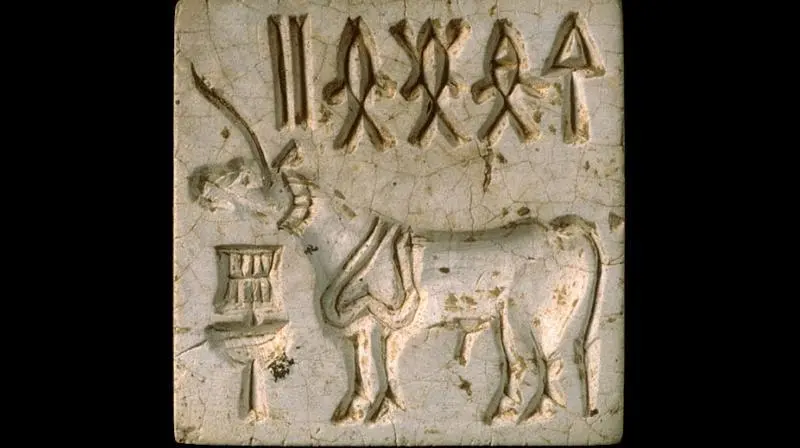
The Harappans had a writing system or at least a system of symbols which can been seen on seals, pottery, tablets, and other objects. Researchers call this the Indus script.
However, the issue is that – we still cannot confidently read it.
Thousands of inscriptions have been discovered, but most are very short and since the language is unknown and there is not a universally accepted bilingual inscription (such as the Rosetta Stone), deciphering the script has proven difficult.
So what is the meaning all of this? We simply do not know because we cannot even read the messages!
What did they say? Did they mention names? Religious ideas? Trade records? Official titles?
We do not know.
This unread script is one of the greatest mysteries left by the Indus Valley Civilization.
What Did the Harappans Believe
The spiritual life of the Harappans is another area filled with many questions. Archaeologists have discovered figurines, seals, and symbolic objects that may have had religious significance. Some of the seals depict animals and human-like figures.
However, it is difficult to interpret these artifacts. It is tempting to directly associate Harappan symbols with those of the later South Asian religious traditions, but historians must be cautious. The evidence is not enough for us to confidently reconstruct the complete belief system of the civilization.
Therefore, instead of saying that we know exactly what they believed, it is better to say that their artifacts reveal a symbolic world, but much of its meaning is hidden.
Perhaps, that uncertainty makes us even more fascinated.
Why Did the Indus Valley Civilization Decline
Around 1900 BCE, the urban system of the Mature Harappan Civilization started to change. Large cities declined, long-distance trade networks weakened, and the settlement patterns started to change.
However, the civilization did not disappear overnight. People still lived in the general area and communities changed their economic practices, settlement patterns and way of life.
So what caused the transformation?
There was probably not a single reason. Researchers have posed various possibilities such as:
Changes in river systems
Climate and environmental change
Shifting rainfall patterns
Declining long-distance trade
Agricultural change
Population movements
The exact combination of these factors is subject to debate. What we can conclude more confidently is that the highly urbanized Harappan system transformed. The cities were changed and the people adapted. The civilization simply moved to a new chapter.
The Civilization that Left More Questions than Answers
The Indus Valley Civilization is outstanding not for the fact that we know everything about it, but because so much is unknown.
We know that the people built cities.
We know they have sophisticated drainage systems.
We know they traded over long distances.
We know they made beautiful pottery, jewelry, tools, seals and sculptures.
We know they lived in one of the world’s earliest urban societies.
However, we still do not know the exact language that they spoke. We do not fully understand their writing. We do not know the names of their rulers (if they had any). And we do not know precisely why their great cities declined.
Thousands of years later, their silence still speaks.
The PixelPen Perspective
History can often be presented as a list of dates.
2600 BCE.
1900 BCE.
Harappa.
Mohenjo-daro.
But, behind every date there was a human life. Someone once walked through those streets. Someone made a clay pot. Someone opened a shop. Someone carved a symbol onto a seal. Someone watched the sun rise over a city that would be discovered thousands of years later.
This is why the Indus Valley Civilization is worth remembering. It wasn’t simply ‘an ancient civilization’ because of its people. It was a world of ordinary people who created something extraordinary. Perhaps, the greatest mystery is the following. What would the Harappans tell us if we could finally read their words?
Until that day, archaeology is our doorway into their world.
And every new discovery is a part of the continuing story.